3D Crystal Roses Pattern Backgrounds
A Designer’s First Look: Whimsy with Weight
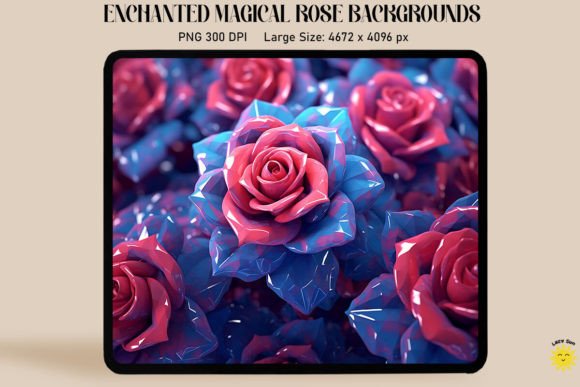
When I opened 3D Crystal Roses Pattern Backgrounds, I didn’t just see roses—I felt the shift in mood. This isn’t a flat floral repeat or a dainty vine. It’s layered, luminous, and quietly dramatic: soft gradients, subtle highlights on petal edges, and that signature “crystal” shimmer suggested through delicate line work and controlled negative space. The layout breathes—it’s not overcrowded, but it’s never sparse. As an embroidery designer who’s stitched hundreds of rose motifs, I immediately sensed its potential for projects where elegance meets approachability: think boutique baby blankets, embroidered kitchen towels for a wedding registry, or a custom apron for a florist-owned café.
How It Translates to Real Embroidery Projects
I tested 3D Crystal Roses Pattern Backgrounds as a full-field motif on a medium-weight cotton twill tote bag—exactly the kind I’d sell in my small shop or list on Etsy as a “hand-embroidered botanical gift.” On fabric, the design held its magic without overwhelming. The petal shapes read clearly in satin stitch, and the spacing between blooms left room for clean fill-stitch transitions. It worked beautifully on sweatshirt fabric too, once I added a light tear-away stabilizer beneath a cutaway base—no puckering, no distortion. For baby embroidery, I’d use it on a soft minky-backed pillow cover, keeping thread colors soft (dusty rose, ivory, pale sage) to preserve its ethereal tone.
Where it shines brightest is in contextual storytelling. A holiday embroidery project? Layer it subtly behind a monogrammed “Joy” script on a linen tea towel. A personalized gift? Use it as a background behind a child’s name on a nursery wall hanging. For apparel decorators, it adds quiet sophistication to the back yoke of a women’s chambray shirt—more distinctive than a generic damask, less fussy than baroque scrollwork.
Where to Proceed with Intention
3D Crystal Roses Pattern Backgrounds isn’t built for every surface—and that’s okay. On highly textured fabrics like bouclé or thick terry cloth, some of the finer petal contours may soften or blur. On stretchy knits (think baby onesies or fitted tees), you’ll need excellent stabilization and possibly reduced stitch density to avoid distortion. Tiny hoop sizes (under 4x4 inches) will force cropping, losing the rhythm that makes this design feel enchanted. And on dark fabric? Test contrast early: white or silver thread can lift the “crystal” effect, but pale pastels may disappear without a backing layer or underlay stitch adjustment.
Curved surfaces—like caps or structured bags—require careful placement. The design’s gentle flow works best on flatter planes; avoid wrapping it tightly around seams or brims unless you’re willing to edit the repeat manually. Also, don’t pair it with ultra-fine lettering or dense decorative accents in the same hoop—its visual weight deserves breathing room.
What It Adds to Your Finished Product
This isn’t just decoration—it’s a value amplifier. Customers notice when a handmade product feels intentional, not assembled. 3D Crystal Roses Pattern Backgrounds elevates perceived craftsmanship: the balance of detail and openness reads as thoughtful, not overworked. For Etsy sellers, it strengthens brand consistency across listings—imagine using it as a subtle watermark in your printable mockups, or as a recurring motif on packaging inserts and thank-you cards. Buyers connect with its warmth and quiet fantasy, making it ideal for personalized gifts where emotion matters more than flash.
It also builds trust. When clients see this level of considered design in a custom embroidered patch or nursery decor item, they assume care was taken at every step—from digitizing to finishing. That translates directly into repeat orders, word-of-mouth referrals, and higher price tolerance for your craft business.
Practical Notes from My Hoop to Yours
- Always test first—on scrap fabric matching your final project’s weight and stretch.
- Review stitch density carefully: if your machine struggles with heavy fills, reduce density slightly rather than skipping stitches mid-hoop.
- Check thread color contrast in both natural and artificial light—some “crystal” highlights rely on sheen, not hue.
- Confirm hoop size compatibility before digitizing adjustments—this design benefits from at least a 5x7 inch workspace for full impact.
- Inspect small details at actual stitch scale: petal tips, stem junctions, and gradient transitions should remain legible, not fuzzy.
- Test black-and-white mockups: if the design loses its personality without color, it may not translate well to thread-limited projects.
- Compare performance on light vs. dark fabric backgrounds—adjust underlay or stabilizer choice accordingly.
- Use proper stabilizer pairing: cutaway for knits, tear-away for stable wovens, and optional topping for napped fabrics.
- Verify licensing terms before selling finished products or bundling 3D Crystal Roses Pattern Backgrounds as part of a digital embroidery file pack.
Final Thought: Not Just a Background—A Quiet Statement
In a market flooded with generic florals, 3D Crystal Roses Pattern Backgrounds stands apart by balancing fantasy with function. It doesn’t shout—it invites closer looking. As a machine embroidery design, it’s versatile enough for custom apparel and delicate enough for baby embroidery, yet substantial enough for commercial embroidery runs or boutique branding. Whether you’re stitching a one-of-a-kind holiday embroidery piece or building a cohesive line of small shop products, this design earns its place—not as filler, but as foundation.